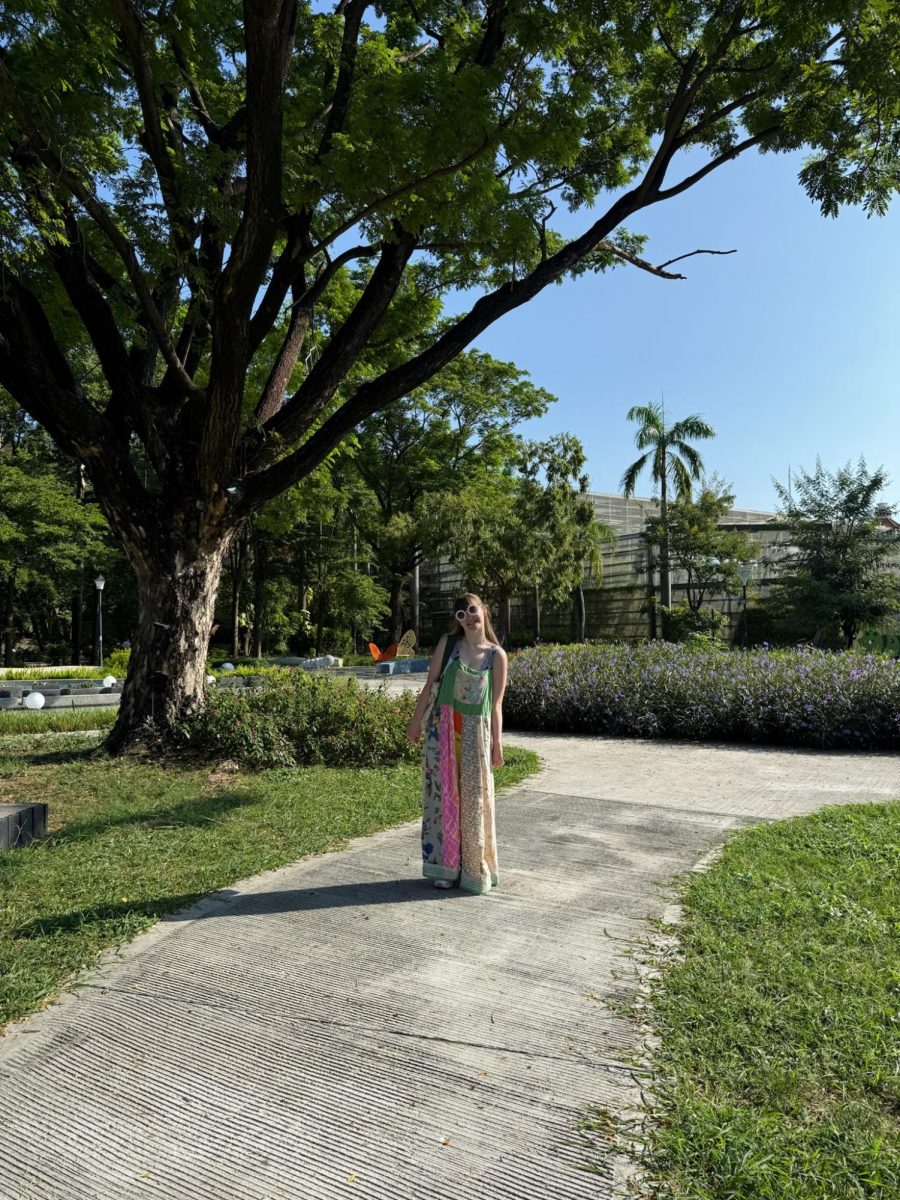
If you saw senior Maggie Graham at prom or graduation and wondered where she’s been all year, the answer might surprise you.
Taiwan.
Graham took part in the National Security Language Initiative for Youth (NSLI-Y), which is sponsored by the U.S. Department of State. This program involves teens studying abroad for a summer or an academic year. Students are able to live with a host family for all or part of the program, and the expenses for tuition, rooms, and flights are all paid for. Graham described the application process as “Pretty much the same as a regular college application process.”
“I would say the biggest difference is it’s like when you apply for college, early decision you’re applying in November. And I applied for this program in November [2024], but I didn’t find out until April [2025].”
Special Education Teacher Maureen Graham, Maggie’s mother, described Maggie as self-motivated during the process, and explained that Taiwan was very close to her family history.
Maureen‘s mother (Maggie’s grandmother) moved from China to Taiwan when she was 18 and lived there for about 20 years before moving to the United States, where Maureen was born. Though her mother never taught her Chinese, Maureen said that she was constantly absorbed in Taiwanese culture.
“I’m a Chinese person that can’t speak Chinese.”
Maureen went on to also impart Taiwanese culture to Maggie. This came in handy when Maggie arrived. For example, when Maggie’s host family offered her squid, though Maggie didn’t really like it, she still knew to compliment the cook, an important aspect of Taiwanese culture.
On Sept. 11, Maggie arrived in Kausuing and started school at the Wenzao Ursuline University of Languages. In the mornings she studied Chinese with about five other students, then spent afternoons practicing Chinese with native speakers.

Initially, Maggie found it difficult to adjust to her new school and environment. The program has her attending a university rather than a high school, so the majority of students are older. Additionally, students closer to her age were focused on studying for college entrance exams.
“They’re [students her age] in school all day, which also makes it pretty hard to make friends with them, because they’re just like, ‘I have school from eight to four, and then cram school from like six to nine.’” Cram schools are after-school programs that students attend to study for college entrance exams.
“The culture is a lot quieter. It’s a lot harder to make friends here than in the States,” Maggie said.
Furthermore, she also said that it was hard for her to make connections at first, especially with her host family, because of language barriers. Maggie said that she barely knew Chinese when she first arrived.
Maggie also said that the strangers constantly treat her like a foreigner.
“People take out their photos to take pictures of me, or film me, especially if I’m out with other people. I was walking to school one time and these people just started chasing me with cameras.”
Since her program is sponsored by the State Department, Maggie is considered a “citizen diplomat.” She attended town halls and other events promoting America with the AIT (American Institute Taiwan), a sort of unofficial embassy. She was expected to attend these meetings, and also give presentations at schools about the U.S. and the culture of the U.S..
Officially, the U.S. government does not recognize Taiwan as an independent country from the People’s Republic of China. However, the U.S. maintains “cultural, commercial, and other unofficial relations” with Taiwan, according to the State department website.
Maggie said people will come up to her to complain about not being able to travel to the U.S. on their Taiwan passport, instead insisting they enter using a Chinese passport. Her only response could be, “I’m really sorry about that. I don’t know what I can do for you there.”
Another struggle with Taiwanese culture that Maggie experienced involved how clothing sizes differed; a U.S. small or medium translates to plus sized in Taiwan.
“I get called row row a lot, which [means] fatty,” Maggie said. “They mean in a kind of endearing way. A lot of girls here straight up don’t eat, and that was something really strange to get accustomed to.”
As she became more acclimated, Maggie started making connections by picking up new hobbies. She said that she was able to join a band, take pottery classes, and even learned to surf. She was also involved in K-pop dance groups, specialized performance teams that create or learn intricate choreography, and perform in public.
“K-Pop is really big here. Everyone loves it.”
Maggie also traveled whenever she got the chance. She loved the Sun Moon Lake, the largest inland lake in Taiwan with picturesque views and activities like biking and boating. She also recommended Tainan City as a great place to visit. Additionally, she enjoyed traveling to the mountains to teach indigenous Taiwanese children English.

Throughout all of these activities, Maggie still managed to keep in touch with her friends and family. She called her friends every other week, and texted them every day. She also called her mom regularly.
Even though they remained close, Maureen still missed Maggie very much, especially during the holidays.
“She left the nest early. She didn’t just go five hours away, she went to the other side of the world.”
She described how hard it was to get gifts to Maggie due to Taiwanese customs and costs to ship internationally. However, she was very proud of her for getting through the competitive application process.
Overall, spending a year in Taiwan changed Maggie’s world view through seeing the differences in culture and society. After traveling, her high school plans have changed from interests involving STEM and medical school to something bigger.
“After coming here, I’m a bit more interested in global health and doing things on a global scale, and international relations.” Maggie will attend Barnard College in the fall, a prestigious private women’s liberal arts college in New York City, affiliated with Columbia University.
She returned to the States on May 6 and was able to still attend prom and walk at graduation with the Class of 2026.
Maggie recommended this experience to anyone interested and felt that taking the leap to miss her senior year was worth it.
“Definitely just go for it, do it. It is very hard, but I think it’s worth it. It’s a very rewarding thing.”