
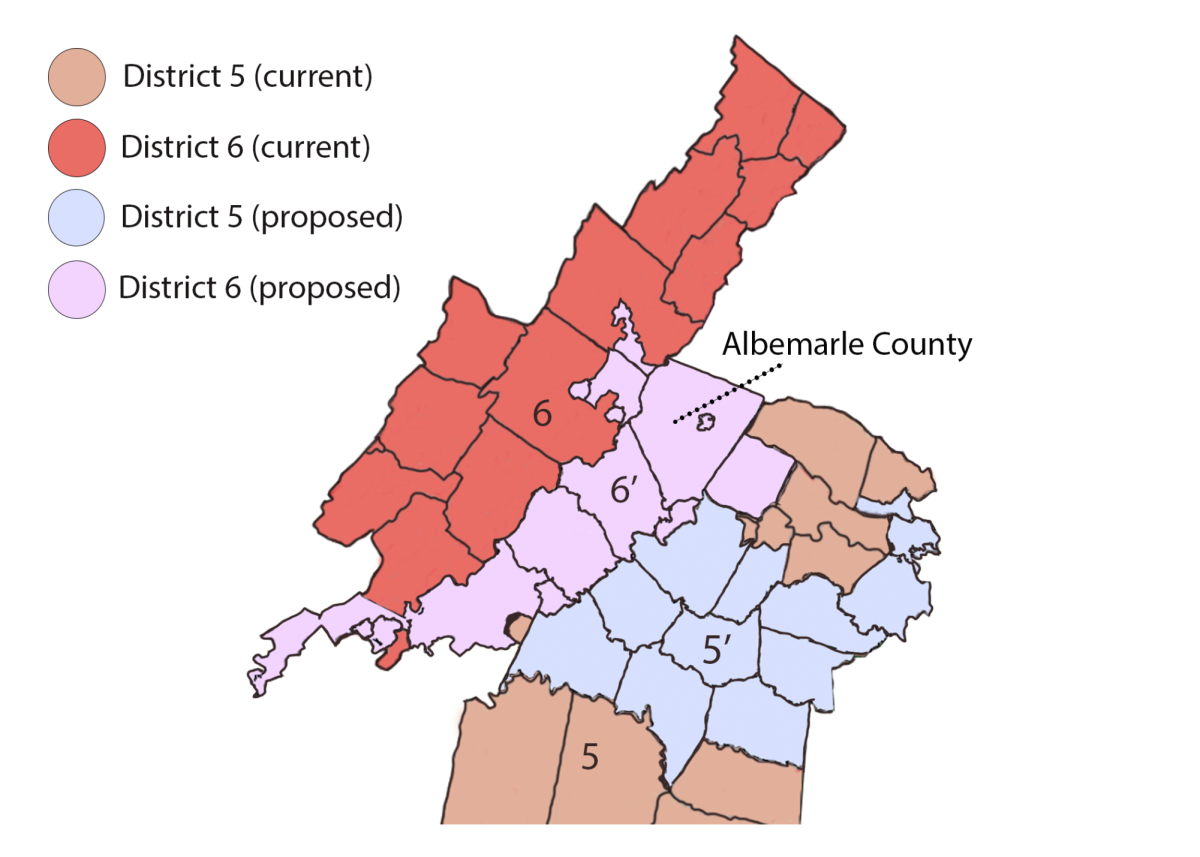
Virginia voters will soon have the chance to decide at the polls whether or not to approve a constitutional amendment that would temporarily redraw the Commonwealth’s congressional districts on Tuesday, April 21.
The amendment, which would expire at the beginning 2031, would give the General Assembly the authority to redraw congressional districts. This would temporarily bypass the bipartisan Virginia Redistricting Commission, which was established in 2020 to prevent partisan gerrymandering.
If enacted, the new map could shift the balance of power from the current 6-5 (D) balance as far as a 10-1 in favor of Democrats.
The referendum hits the polls in the midst of a nationwide wave of redistricting that began last summer when President Donald Trump began floating the idea to secure a Republican victory in the upcoming 2026 Midterm elections. While redistricting normally only occurs after the census, the White House urged states like Texas, Indiana and Ohio to undertake mid-decade redistricting in order to create redder maps and blunt a 2026 blue wave.

However, Trump’s consistent pressure campaign on state legislatures was met with significant Democratic blowback at both the state and national levels. Texas House Democrats staged an elaborate walkout to Chicago (with the blessing of Illinois Governor J.B. Pritzker) in an attempt to deny the state legislature a quorum to proceed with voting on the amendment. While the new map was ultimately passed, the Democrats succeeded in delaying the process by two weeks and conjuring a national media blitz.
Elsewhere, Indiana state Senate Republicans and Democrats united to defend the state’s existing 7-2 (R) map from a proposed 9-0 gerrymander, and ranking Ohio state legislators struck a deal with Democrats to only pick up one seat in order to avoid an expensive referendum fight.
Democratic governors across the country have also pushed for counter-gerrymandering in their states to check the Republican push. In 2025, California passed the Election Rigging Response Act, also known as Proposition 50, by referendum to create more blue-leaning House districts. Maryland Governor Wes Moore is in the midst of a battle with his own state Senate to shift from a 7-1 (D) to a 8-0 map.
On Nov. 4, 2025, Virginia Democrats secured the Governor’s Mansion and the upper and lower houses of the General Assembly with larger than expected margins, creating a trifecta and near-legislative supermajority of 64-36. After clearing the state House, Senate and litigation, referendum voting is set for April 21.

If passed, the new map would shift Albemarle county to a relocated 6th District while shrinking the 5th, which is where the county currently sits. It would also dramatically enlarge the 4th, 8th, 9th, and 11th districts, while the 2nd and 3rd would remain relatively unchanged.
It remains to be seen how popular the proposed amendment is with voters. According to a poll by Roanoke College conducted in mid-February, only 44% of voters support the referendum, while 52% desire to wait until the 2030 census. Early turnout has also favored the GOP despite a Democratic fundraising edge. However, a newer Washington Post-Schar School poll published on April 3 found that 53% of voters are now in favor of the measure with 44% opposing it.
You can use this website to register to vote for the April 21 special election. In order to be eligible, you must register by April 14, or seven days in advance.











Kim Swanson • Apr 21, 2026 at 8:24 am
Thank you for explaining. One thing that I learned as a result of this special voting opportunity is that IF a citizen WILL turn 18 BEFORE the November elections, they were eligible to register
AND vote in this referendum. Not sure if this helps anyone on the fence about getting their kid out for this special voting opportunity. It was news to me.